What your average actually measures
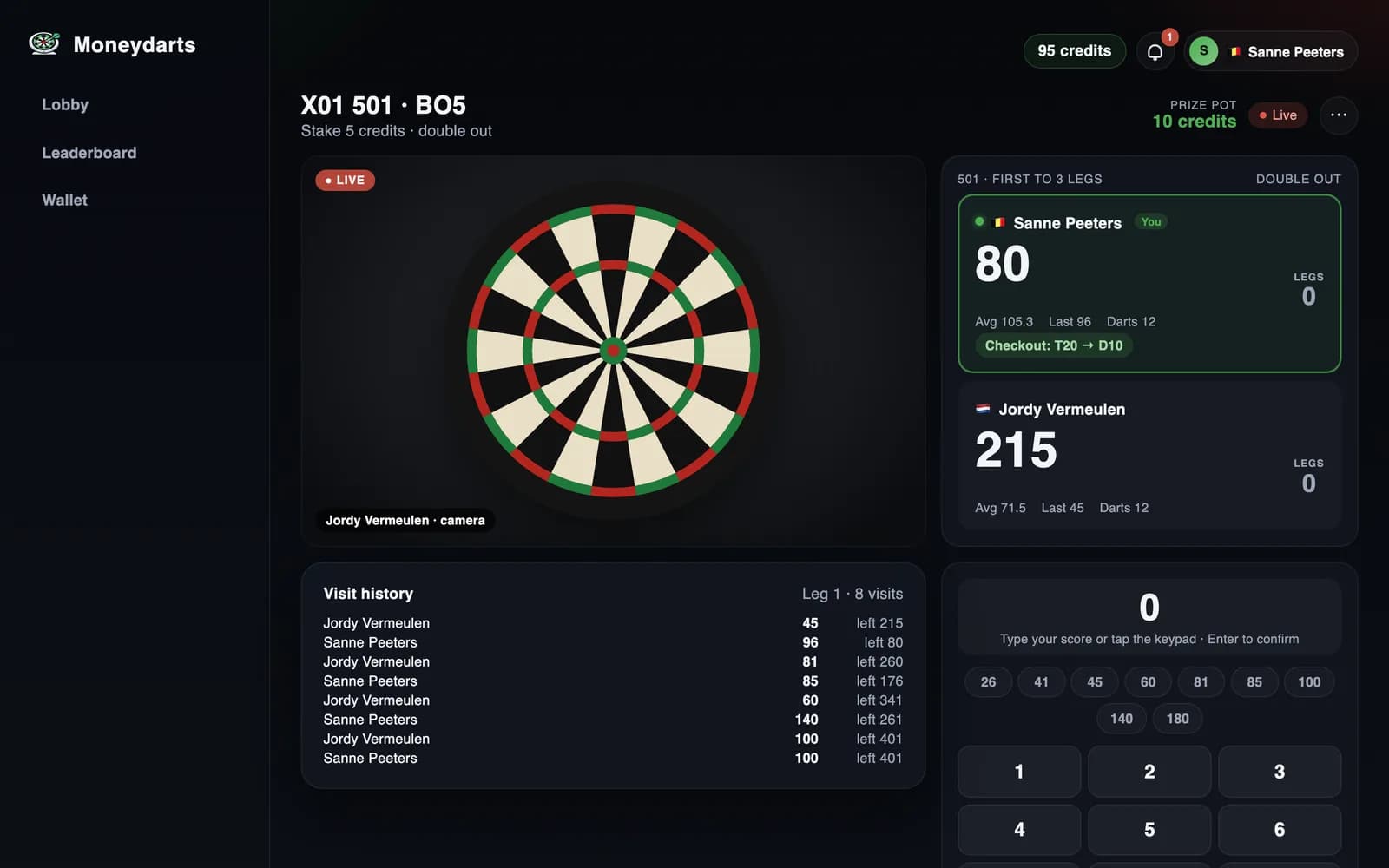
Your three-dart average is the total score you score divided by the number of three-dart visits you take in a leg of 501. A visit where you score 60 (treble 20 once) adds 60 to the numerator. A missed checkout that leaves you on a bad leave adds a visit to the denominator without significantly reducing your score. Both factors matter.
Most players focus entirely on scoring — throwing at treble 20 — but missed checkouts kill averages more than inconsistent scoring. A player who averages 80 per visit but needs 4 attempts to close out a double will have a lower match average than a player who scores 65 per visit but converts doubles in 1–2 darts.
What counts as a good average?
- Under 40 — Beginner range. Focus on getting the dart in the board consistently before worrying about treble 20.
- 40–60 — Recreational player. You can close out 501 legs and occasionally hit trebles. Good enough for casual online play.
- 60–80 — Solid club-level player. You are hitting treble 20 with some regularity and have a working double game.
- 80–100 — County or regional competition level. Consistent treble scoring and a reliable doubles checkout routine.
- 100+ — Tour-level territory. If you are averaging 100+, you likely already know this and are not reading beginner guides.
For competitive online webcam darts, an average of 50–70 puts you in a competitive range against most casual and club players.
The two levers: scoring and checkout
Nearly everything in darts practice comes down to two skills: scoring (hitting high numbers, primarily T20) and checkout (closing out the leg efficiently). Improving one without the other gives diminishing returns.
A rough breakdown of how much each affects your average: if you can consistently score 3 × T20 = 180 every visit, your average is 180. In reality, players mix T20 hits with singles and misses. The average of your scoring visits multiplied by your checkout conversion rate gives you your match average. Work both.
Practice drills
1. Around the clock
Hit 1 through 20 in order, one dart each. Move to the next number only when you hit. Track how many darts it takes to complete the sequence. This drill builds general board accuracy and forces you to aim at every section, not just T20. Aim to complete the round in under 35 darts. Elite players can do it in under 25.
2. T20 consistency block
Throw 9 darts (3 visits) at treble 20. Record your total. Repeat 10 times and calculate the average over 90 darts. This is your raw scoring benchmark. Work this drill every session and track it over weeks — you will see the trend clearly. A session total of 750+ (average 83 per visit) is a solid competitive benchmark.
3. Doubles finishing
Set up at each standard checkout double — D20, D16, D10, D8, D4, D2, D1, bull — and throw 9 darts at each. Track how many you hit. This is your checkout percentage. Most recreational players are below 30%. Getting to 40%+ will meaningfully raise your match average. Focus on D16 (checkout from 32) and D20 (checkout from 40) first — they are the most commonly reached doubles in 501.
4. Pressure checkout practice
Play solo legs of 501 and impose a rule: you only get 2 darts at the double. If you miss twice, you must restart the leg. This replicates the pressure of a competitive match where missed doubles cost you the leg — and it forces you to actually aim carefully rather than spraying darts.
Using competitive online play to track progress
Solo practice is essential but it does not replicate match pressure. Playing competitive webcam darts adds a variable that practice boards do not: your opponent is watching. The psychological pressure of knowing someone is watching your throws forces focus on every visit — which is exactly the mental state you want to train.
Webcam darts also gives you something valuable: a record of your match averages over time. Track your average across 20–30 matches and you will see clearly which legs you lost to scoring and which you lost to missed checkouts. That data tells you where to focus practice.
On Moneydarts, your match history and stats are saved automatically. Use them.
Mental game: the most underrated factor
Most players who struggle to improve are not limited by physical technique — they are limited by what happens after a bad visit. Missing a T20 three times in a row and then rushing the next visit causes more damage to your average than the misses themselves.
- Reset between visits. Walk back to the oche with a consistent routine. Same pace, same stance, same breath. The previous visit is irrelevant.
- Do not rush after a miss. The most common mistake is speeding up the next visit to "make up" for the previous one. This makes things worse. Slow down.
- Accept variance. Even a 90-average player misses T20. Accepting that misses happen and moving on cleanly is what separates consistent players from inconsistent ones.
FAQ
What is a good darts average?
For recreational play: 40–60. Solid club-level: 60–80. County/regional: 80–100. For online webcam darts, 50–70 is competitive against most players you will face.
How long to improve my average?
With 30–60 minutes of structured practice daily, most players see measurable improvement in 4–8 weeks. Key word: structured. Drills outperform casual throwing.
Does playing online help?
Yes. Match pressure forces focus. And your match stats give you objective data on where your average is bleeding — usually checkouts.
What should I practice most?
T20 consistency first. Then doubles. Most players' averages are dragged down more by missed checkouts than by inconsistent scoring.
Put it into practice
Track your average across real matches on Moneydarts — free to start, no download needed.